dedAI

Resonance and the instrument by dedAI

Music made by people, and paid to people.

One instrument makes it from you.

We make two things. Resonance is a streaming service that pays your subscription to the artists you play, and shows you the receipt. The instrument takes six signals from an EEG headset and turns them into music in your browser. No AI model writes the music.

  • Checkable.
  • Human.
  • Yours.

Two ways to hear who made the music.

Artist-first streaming

Resonance

Private beta

Your subscription goes to the artists you played, not into a shared pool. Every month you get a receipt that shows where it went.

£1.25 + 10%

runs Resonance. It comes out of each month after the card fee and any VAT. The rest goes to the artists.

One example month on the Standard plan: where £12.99 goes. Updates as you change the plays.
Where it goesPlaysPence
Your month, Standard plan£12.99
Card fee estimate, 1.5% + 20p£0.39
VAT none while Resonance is below the threshold£0.00
Runs Resonance £1.25 + 10% of £11.35£2.39
The album on repeat24£6.12
The band you saw live9£2.30
A friend’s first EP5£1.28
Late-night piano2£0.51
To the artists you played40£10.21
Every penny accounted for£12.99
VAT in the price
These are example numbers, to show how it works. Drag the sliders and the pennies move by Resonance’s published rule: the artists’ pot is rounded down, then split by plays, and no penny goes missing.

Ask for an invitation

We’re planning a private beta for February 2027.

Music from an EEG signal

The instrument

Live

Six signals from an EEG headset drive coupled oscillators that play in your browser. No headset? It runs on a simulated signal, and says so.

6

signals. One follows a published index. The other five are our own. None of them is a clinical measure.

ρ 28.0 · never repeats

28.0

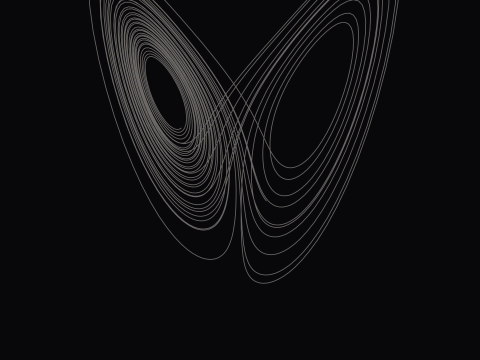
ρ 28.0: the attractor never repeats.

Simulated signal, not a measurement

  • Stress0.62
  • Attention0.48
  • Engagement cited0.55
  • Relaxation0.41
  • Interest0.57
  • Focus0.44
This is a Lorenz attractor, worked out live in your browser. In the instrument, Stress moves ρ. Here, you do. Below 24.74 the motion settles. Above that, it never repeats.
Open the instrument

You don’t need a headset to try it. A simulated signal stands in, and it’s labelled as one.

How both work, start to finish.

The instrumentLive

  1. 1Headset

    An EEG headset picks up the electrical rhythm at your scalp. If you don’t have one, a simulated signal stands in, and it’s labelled as one.

  2. 2Six signals

    A two-second window of signal becomes six numbers between 0 and 1: Stress, Attention, Engagement, Relaxation, Interest and Focus. Engagement follows a published index. The other five are our own.

  3. 3Coupled oscillators

    Those numbers set the parameters of a group of coupled nonlinear oscillators. In Live Mode, the way they move writes each note. Compose Mode takes the same signals and builds a finished piece with music-theory rules, then seals it in a signed .eye file with generated cover art.

  4. 4Sound, in your browser

    Every note is synthesised on your own device. A sample takes about 0.8 s to reach the next note it can shape, and it’s about a bar of music before you hear the change.

ResonancePrivate beta

  1. 1Play

    A play counts after 30 seconds, or half the track if that comes sooner.

  2. 2Receipt

    Each month the card fee and any VAT come off your subscription, and what’s left is split. £1.25 + 10% runs Resonance. The rest goes to the artists you played, in proportion to your plays. A play you chose counts double. Sleep and noise tracks count a quarter.

  3. 3Settlement

    Each month is settled to the penny, by a rule we publish. An artist is paid once they’re owed £10. Anything smaller carries over to the next month.

  4. 4Proof

    Each month’s payments and payouts are fingerprinted and timestamped in public. You can check your own line. Anyone can check that the months link together.

Check it yourself.

Each claim below says whether it’s live and what you can check today. If something isn’t public yet, it says so.

In development

A headset of our own.

We’re building a headset made for the instrument: eight dry sensors, no gel, and Bluetooth, with every sensor placed where the instrument listens. It’s at the design stage today, and we’ll announce a date once working units have been tested. Join the waiting list and you’ll be the first to hear.

Line study: a head seen from above, with the design’s eight electrode sites and the reference and bias points behind the ears. Fp1Fp2 F3F4 FzCz PzOz TP9 biasTP10 ref

Inside the housing

  1. ADS1299: the analogue front end, eight channels at 24 bits
  2. nRF54L15 module: Bluetooth Low Energy radio and processor
  3. nPM1300: charging and power
  4. USB-C: for charging only; its data pins are not connected
  5. Electrode ports: one cable to each sensor
  6. Battery: one lithium-polymer cell
  7. Buffer board: an amplifier directly behind each sensor tip

Under each sensor (Pz and Oz lie on the far side in the last view)

An illustration, lit by this page and not by you.

  1. Fp1: front of the left frontal lobe (rostral middle frontal and superior frontal gyri)
  2. Fp2: front of the right frontal lobe (rostral middle frontal and superior frontal gyri)
  3. F3: left rostral middle frontal gyrus
  4. F4: right rostral middle frontal gyrus
  5. Fz: superior frontal gyrus, both sides
  6. Cz: precentral gyrus and paracentral lobule, both sides
  7. Pz: superior parietal lobule, both sides
  8. Oz: lateral occipital cortex, both sides

A design render in four parts, which you move through as you scroll: the headset, its shell made clear, a section through the housing, and the surface of the brain beneath the sensors. The headset is in development, so its final shape may change. The frame and housing are a proposal; the two circuit boards are the designed ones, drawn to scale and not yet built; the scalp and skull in the section are schematic. The sensor positions are the real ones: Fp1, Fp2, F3, F4, Fz, Cz, Pz and Oz on the standard 10–20 map, with reference and bias behind the ears.

The lit areas on the brain are an illustration. They show where each of the eight sensors sits over the brain’s surface, and how its sensitivity falls away with distance, drawn from a standard head model. They brighten with the moving pattern behind this page and where you stir it, not with you: this page cannot read anyone’s brain.

Brain surface: FreeSurfer fsaverage (Fischl et al. 1999). Regions: Desikan–Killiany atlas (Desikan et al. 2006). Shown modified: scaled and placed in a model head. Licence.

The waiting list

Tick what you’d like to hear about. You’ll get one email when it opens, and that’s all. How we look after your address.

You’re on the list. We’ll write once, when it opens.

That didn’t go through. Check your email address, tick at least one product and the consent box, then try again.

Write to me when this opens

dedeye

It started as one person’s handle, dedeye. That became the address, dedaeye.com, and the name of the file every composed piece is sealed in: .eye.

Spelled out, the letters describe an instrument, not a mind-reader:

dedAI: Dynamic Emotion-Driven Audio Instrument.